QRS research programme · Fine-tuning · Attention

GeoAFT

Geometric Attention Fine-Tuning

Adapting how representations relate to one another, not only the representations themselves.

A pretrained Transformer learns representations and a rule for comparing them. Fine-tuning usually changes the first. GeoAFT adapts the second.
Active

Lead: Yuhe Sui

Workshop paper: NeurIPS 2026 AutoMLR

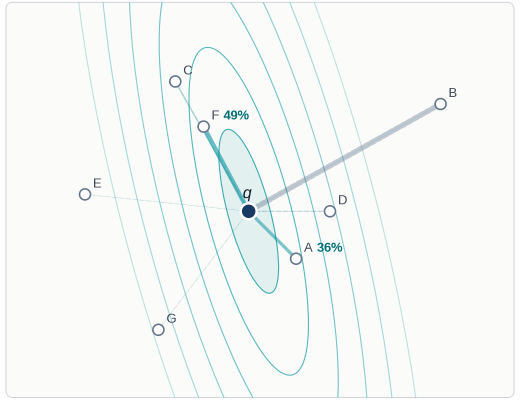
Illustration: the same query and keys under two compatibility rules. Pretrained dot-product attention concentrates on key B; after the geometry is adapted, attention moves to F and A. The points never move.
Rings and grid are the ruler; colour is compatibility with q. The geometry changes, attention re-ranks, the points stay put. Pretrained dot-product attention concentrates on key B. After the geometry is adapted, attention moves to F and A. The points do not move. Illustrative 2-D toy.

GeoAFT at a glance

The idea

LoRA-style methods change how queries and keys are produced. Geometric attention fine-tuning changes how they are compared:

Sij=sbase(qi,kj)+αhg¯ϕ(Pqqi,Pkkj)

gϕ is a small trainable geometry. The gate αh starts at zero, so training begins from exactly the pretrained attention.

Experiments

Synthetic tested

Learned Lp99.983%
Mahalanobis99.991%
Nonlinear99.934%

Recovery of three known target relations, not classification accuracy. Tested against Q/K-LoRA, a fixed geometry bank, generic pair-MLP scorers and exact controls.

Real benchmarks In progress

Evaluation on natural tasks is ongoing. No natural-task or state-of-the-art result is claimed.

Where this is going proposed

  1. When is geometry adaptation actually different?

    Pair every geometry family with a containment control, and go beyond today’s families to spherical, hyperbolic, mixed-curvature, local-metric, learned-kernel and dynamic geometries.

  2. Can geometry become conditional?

    Let the geometry depend on the input, layer, head or local statistics instead of one global metric.

  3. Does it survive beyond attention and under compression?

    Test JEPA-style latent prediction, encoder, vision and decoder-only models, and BF16 → INT8 → INT4 precision.

The research questions in full, on qrsntu.org →

Accepted research

Geometric Attention Fine-Tuning Is Representation-Relative: Autonomous ML Research with AI-Native Workflow

Yuhe Sui, Jianing Zhang, Shufang Chen, Xiaotong Li, Wang Zimeng

NeurIPS 2026 AutoMLR · 2026 · Accepted [OpenReview]

Related projects

AI-Native Workflow, GeoAttention

Full project

How it works, on qrsntu.org →

← All projects